La Hora Chapina

“In the interest of efficiency (though without fully understanding why efficiency is always imperative), we have entered a world of interaction without personal contact.”
Absolute bar.
This was written by Elissa Ely who is a psychiatrist as well as a columnist for the Boston Globe. My Mom recently sent her article my way and this first line really struck a chord with me.
What she writes is so true. We live in a world where efficiency is highly valued, but we don’t ever stop to consider why. Yes, it’s nice to be organized, to have things run on time, and to have a planned out schedule, but at what cost? To what extent are we willing to give up getting to know the people around us, in return for a well-ordered society?
I have certainly noticed how much this prioritization of efficiency is ingrained within my American bones. Having now lived in Guatemala for two months, I’ve observed a different pace of life here. They even have a name for it: ‘la hora chapina' or ‘Guatemalan time’. It essentially means that things will happen when they happen, likely later than their scheduled time.
Sometimes this slower way of living doesn’t totally jive with me. Quite frequently while walking down the main street in town, I get caught behind a family strolling at a more leisurely pace. For a moment, I pause and tell myself to just follow along behind them. Where do I need to be in such a hurry? I ask myself. But that moment of introspection typically lasts for about eight seconds until I decide to slyly overtake them.
This yearning for efficiency is not just within me, I’ve observed, but also within many of the visitors who come to the Mission. Sometimes it can be difficult as a Long Term Volunteer to manage peoples’ expectations about our schedule. A coffee presentation might start ten minutes late because Giovanni and Edy want to crack some jokes. Or we may show up to a construction site ready to work, but the contractors want to take a moment to chat with us and share a coke before getting to mixing cement.
This stark contrast between the U.S. and Guatemala makes me wonder even further: why do we value efficiency so much? Guatemala certainly has a less efficient and less timely way about her, but arguably a lot stronger sense of community and overall happier population. But in the U.S., we think efficiency is top dog. We arrive on time to meetings and appointments leaving no room for small talk with our fellow humans. We go straight from work to the gym to the grocery store every day, yet we might not even know the name of the lady who works the front desk of our YMCA. In the U.S., it feels as if everything we do is already preprogrammed. Our schedule is set and there’s no deviating from it.
This is understandable. Time goes fast and so we want to be productive with the small amount that we have. But what are the benefits of such a highly productive society? Maybe we get all our projects at work done on time, but then we don’t genuinely know our co-workers on a deeper level.
However, what if it didn’t need to be this way? Not everything in life needs to be executed in the most methodical manner. We can have meetings and chat a little bit about how everyone’s families are doing. Or we can go to the gas station and talk with the person filling up our tank, establishing a relationship with them. When someone asks us how we are doing maybe we can respond with more than just, “Good, and you?”
I don’t think life is meant to be a+b=c. Yet unfortunately, we often view life as a mathematical equation in the U.S. We think that our time is limited and that’s scary so let’s maximize our time to the best of our ability, even if that means foregoing genuine human interaction.
However, I think Guatemalans generally understand that we shouldn’t treat life like a calculus class. We are cheating ourselves of so many opportunities and interactions when we let efficiency dictate all of our decisions. Life is go with the flow and roll with the punches.
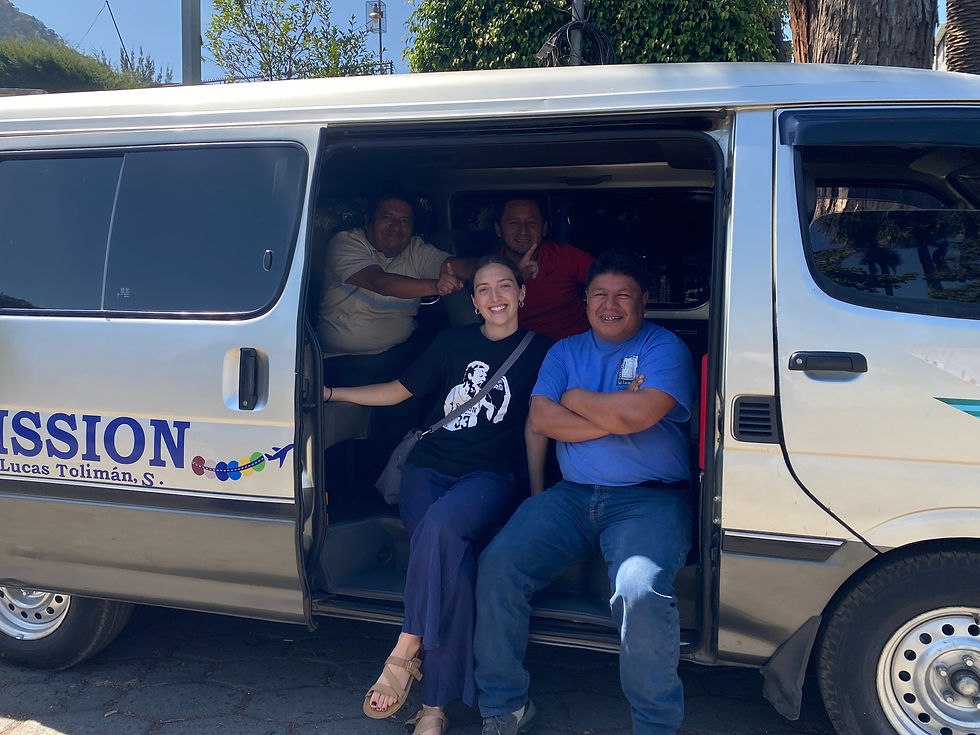
This 'hora chapina' mentality I mentioned previously doesn’t mean that Guatemalans are not punctual. Every Sunday like clockwork, the church pews are filled by 4:50 pm. I have learned to arrive early to mass, or else I'll have to stand in the back of an overflowing church. Additionally, Nelson, one of the Mission’s drivers, is one of the most timely people I have ever met. He arrives to work thirty minutes early every morning to clean his van just for it to get dirty later in the day. But Nelson takes pride in his punctuality and the presentation of himself and his prized van.
Guatemalans can certainly be punctual, but they’re punctual without sacrificing real human connection.
I think punctuality and efficiency in this way do not compromise the fullness that life has to offer. After mass has finished, churchgoers gather outside to talk and eat dobladas on the street. Yes, they arrive on time, but they don't beeline home once the hour-long mass is up.
Once Nelson finishes cleaning his van, he shares a coffee and a laugh with Edgar, one of the other drivers, almost every morning. And without missing a beat Nelson will get on the aux the moment that visitors get in the car to keep the vibes high. And he will make endless jokes with you during your drive with him. Nelson is not solely focused on doing his job and getting the visitors to their destination in the most timely manner, but also enjoying the journey along the way.
So I challenge us all when we catch ourselves in such a hurry to stop and ask: Why am I in such a rush? What is taking me away from appreciating the people and the journey along the way?


Comments